Showing posts with label Info about 4WD. Show all posts

20 November 2009

Who Built the first 4WD ?

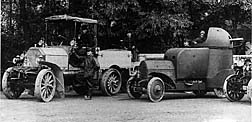
Historians seem 'not certain' who invented four wheel drive for car but somehow the history of 4WD is not well recorded. According to what I found in the internet, the first 4WD vehicle was designed by Ferdinand Porsche (The founder of Porsche cars) for the Austrian manufacturer Jacob Lohner in 1900.

First mechanical 4WD (transfer case, drive shafts etc.) was built by the Dutch company Jacobus Spyker in 1902. Since Lohner /Porsche four wheel drive has such an unusual status with its electric hub motors the Spyker is considered to be the world's first four wheel drive car.

more..in spykers car.com or 4WDobline.com

The world's first automaker, Daimler Benz has a solid place in 4WD history as well. Mercedes started building 4WD vehicles in year 1903.

Who ever built the first 4WD is the history for us to know but they really have created the machine for us to drive.

03 November 2008

4WD diesel engine or petrol engine?

I have received a comment on which to choose either diesel engine or petrol engine.

There are a few criteria that we need to take into consideration before choosing to buy diesel engine or petrol engine.

Here some tips that I can suggest and hope they are useful.

Engine Price

Usually in Malaysia diesel engine is more expensive compare than petrol engine especially with turbo intercooler system. I am not very sure about the other country pricing.

Engine power

Only diesel engine supported with turbo system able to produce more power and sometimes as good as petrol engine. Petrol engine normally have more power compared with diesel engine roughly about 25%.

Torque

Diesel engine able to generate more torque in low r.p.m and therefor capable to carry more load and have ability to go for long distance journey. Petrol engine have more horsepower and high acceleration but low torque.

Maintenance

Simple maintenance, pay attention on your engine oil (high frequency of changing your engine oil) and if properly maintained it may take longer time for major overhauls. Petrol engine may require more complex maintenance.

Life time Engine

For diesel it may take between 350,000 km to 500,000 km for general overhauls. As for petrol it may take between 200,000 to 350,000 km for general overhauls.

Fuel Consumption

I think when thinking of buying a car or 4WD you may find that diesel engine able to save about 20% to 50% compare with petrol engine

Exhaust Temperature

For diesel engine the exhaust temperature about 600 degree celcius and as for petrol engine about 800 degree celcius. The high temperature of your 4WD the more inflammable.

There are other tips in my opinion that you may find it useful such as how easy to find a mechanic, price, car insurance, availability and price of 4WD spare parts and in Malaysia you may include also roadtax and etc.

But if you buying a 4WD for offroad then you have to take consideration on basic tips such as engine breaking, endurance, torque, maintenance, body lifting, suspension and etc.

27 September 2008

What is 4WD System?

The main component that differentiate the 2WD (normal vehicles) and 4WD is on their transmission system or an automotive drive system in which mechanical power is transmitted from the drive shaft to all four wheels.

Normal vehicles only powered by main gear transmission box as compared with 4WD vehicle is also attached additional gear box or transfer case/gear which usually located behind the gear transmission box.

Transfer case main function is as a housing for drive shaft/propeller shaft to move the wheel forward and backward. Transfer case box possess 2 additional set ratio gear that are high (4 High/4H) and low (4 Low/4L).

When you choose a low gear ratio that mean you are doubling the torque to the wheel. Low torque circle with the mechanical transmission system enable all four wheel advantage to climb or to carry heavy load. Please remember that with 4 Low gear ratio does not give you wheel grasp but only to supply more torque for your wheel.

There are two type of 4 wheel system that is full time 4WD and part time 4WD.

In my case,my Mitsubishi Pajero is classified as a part time 4WD and this type of 4WD become more popular in Malaysia.

When to use 4H:

  • for traction when the area isn't steep
  • when stuck in sand
  • extremely slippery conditions
  • snow
  • ice
  • rocky, gravel roads
  • gullies
  • extremely muddy areas
  • ridges

Low Range 4WD

4L is for creeping along at slow speeds. It reduces the strain on your vehicle, just remember to stay below 25mph in low range. While it does not provide more traction, it does provide 2-3 times more torque at about 1/2 or 1/3 of the speeds in high range. Low range gear ratios are approximately half that of high range.

When to use 4L:

  • on wet, slippery surfaces
  • passing through sandy areas
  • on rough trails
  • through shallow water
  • rock-climbing
  • climbing steep hills
  • through mud
  • descending steep hills
Additional Tips:

Don't change gears in the middle of a water crossing, going up or down hills, or in sand dunes.

Be prepared: Engage low-range 4WD before you need it.

Don't operate 4WD on hard dry surfaces.

When in doubt, use a lower gear!